
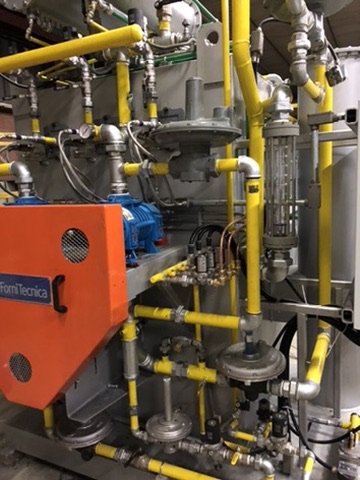
An endogas generator produces a carrier atmosphere used for carburising, carbonitriding, hardening and protective annealing. Gas quality depends on the balance between temperature, air-to-gas ratio, catalyst activity and final cooling.
Operating principle
In a conventional generator, air and natural gas are metered and reacted inside a heated retort containing a nickel catalyst. The resulting gas consists mainly of carbon monoxide, hydrogen and nitrogen, with smaller amounts of carbon dioxide, methane and water vapour.
- Stable metering of air and natural gas
- Correct catalytic-zone temperature
- Rapid cooling of the produced gas
- Pressure and flow control
Role of the catalyst
The catalyst promotes the reactions without being consumed directly. Over time, its activity can decline because of contamination, thermal shock, sulphur or carbon deposits.
- Increase in residual methane
- Reduction in CO
- Maggiore instabilità dell’atmosphere
- Increased soot formation
Why the air-to-gas ratio is critical
Excess air increases oxidising species and reduces carbon potential. Too little air can increase residual methane and promote soot formation. The ratio should not be adjusted by guesswork; it must be verified against gas composition and retort conditions.
Recommended checks
- CO, CO₂ e CH₄
- Dew point
- Catalyst temperature
- Pressioni e portate
- Stability of the air-to-gas ratio